The Voice of Janesville and Rock County
PUBLIC ACCOUNTABILITY • CIVIC LITERACY • COMMON-SENSE CONVERSATIONS
Vol. 2, No. 48 – November 6, 2026 – 1920 words – a seven-minute read.
____________________________________________________________________________________
THE ELECTION IS OVER. THE BUSINESS OF GOVERNMENT BEGINS.
Rock County needs informed citizens, responsible public servants, and a renewed commitment to representative democracy.
The Rock County Civics Academy | Candidate Education Series — Part One
Another election is behind us. The votes have been counted, winners and losers have been determined, and campaign signs will soon disappear from our streets. But don’t mistake the end of an election for the resolution of the issues that brought us to the polls.
Nowhere is that more evident than in Janesville.
Regardless of how voters decided the GM/JATCO referendum, one thing is certain: We know remarkably little more about the long-term future of that property than we knew before Election Day. The referendum addressed a question about voter approval of certain future development proposals. It did not produce a redevelopment plan, resolve the property’s environmental challenges, identify a prospective developer, or establish what the community should expect from this valuable public asset.
___________________________________________________________________________________
REALITY CHECK NUMBER ONE:
In some respects, we have an even more complicated challenge ahead. Janesville is a divided community, and the debate has exposed something more consequential than disagreement over a development proposal. It has revealed a substantial erosion of public confidence in local government.
___________________________________________________________________________________
That distrust did not originate with GM/JATCO, and it will not disappear with the referendum.
Interestingly, data centers became the common thread uniting people on opposite sides of the controversy. They may disagree about development, economic opportunity, environmental concerns, and the appropriate role of citizen participation. But many share a fundamental concern: Do they have the information, opportunity, and confidence necessary to understand what their government is doing?
That is a question deserving serious attention.
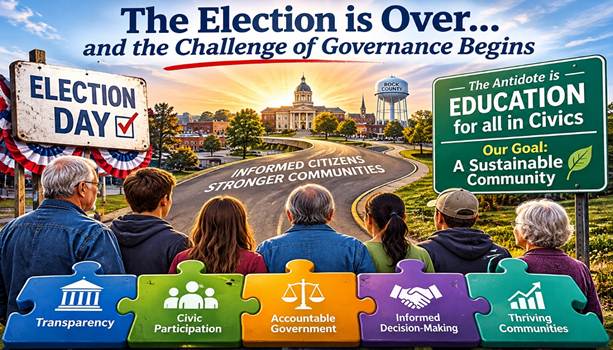
The Challenge Ahead: Healing and Reform
As Janesville approaches its April municipal elections, rebuilding public trust should be a priority for the current and incoming city leadership.
Healing does not mean asking people to abandon their convictions or pretending that legitimate disagreements never existed. Nor does reform mean automatically accepting that every criticism of government is justified. It means establishing a better way forward.
That requires greater transparency, meaningful public participation, consistent communication, clearly understood decision-making procedures, and a willingness by elected officials to explain not only what they decide, but why.
It also requires citizens willing to listen, examine evidence, distinguish fact from speculation, and recognize that disagreement is not a reason to abandon constructive community relationships.
When Money Enters the Local Political Arena
Another development deserves our attention: the growing influence of money in local elections and public policy debates.
The most recent Janesville municipal election cycle saw record levels of spending by City Council candidates. The GM/JATCO controversy subsequently demonstrated how substantial financial resources can be deployed to purchase advertising, promotional materials, and organized public messaging in an effort to influence a local decision.
When significant sums are spent, citizens have a legitimate interest in knowing who is paying, who is organizing, and whose interests are being represented.
Money does not automatically invalidate a political argument. Nor does spending establish that a position is right or wrong. But transparency about the sources and purposes of political spending is essential to public confidence.
When residents cannot readily identify who is financing the messages competing for their attention, skepticism naturally follows.
We should not assume that those with the deepest pockets have the best answers, the broadest community support, or the public interest foremost in mind.
The antidote is an informed citizenry.
Knowledge Is the Antidote
Here is where the Rock County Civics Academy believes it can make a meaningful contribution.
The greatest vulnerability in our local democracy may not be a lack of opinions, political passion, or public participation. It may be a lack of accessible, understandable, reliable information about how government actually works.
What authority does the city council have? How are public budgets developed? What are the financial consequences of development decisions? Where does municipal responsibility end and county or state authority begin? How should citizens evaluate competing claims about economic development, environmental impacts, taxation, and public services?
These are not questions reserved for elected officials. They are questions every engaged citizen should be encouraged to understand.
Education is not about telling people what to think. It is about giving them the knowledge and tools to think critically, ask better questions, and make informed judgments.
Responsible Public Service Is a Shared Responsibility
Winning an election is an accomplishment. Being prepared to govern is a responsibility.
Public officials must understand the authority entrusted to them, the financial and legal consequences of their decisions, and their obligation to represent the entire community, including those who disagree with them.
But citizens have responsibilities, too. Representative democracy does not end when we cast our ballots. It depends upon an informed public that remains engaged, holds its representatives accountable, and participates constructively in community affairs.
____________________________________________________________________________________
REALITY CHECK NUMBER TWO:
Healing does not mean asking people to abandon their convictions or pretending that legitimate disagreements never existed
____________________________________________________________________________________
Neither side can do the job alone.
Over the coming weeks, the Rock County Civics Academy will explore the qualities, knowledge, and commitments necessary for effective civic leadership and responsible public service. We will examine what it takes to move from being a candidate seeking public office to becoming a public servant prepared to govern.
Our objective is not to endorse candidates, prescribe political positions, or advance a particular policy agenda. It is to encourage informed citizens, better-prepared public servants, and stronger deliberative democracy throughout Rock County.
Because our communities deserve more than another election cycle of competing promises, expensive advertising, and political division.
They deserve thoughtful leadership, accountable government, and citizens equipped to participate in the decisions affecting their future.
The election is over. The business of government begins.
And rebuilding confidence in that business belongs to all of us.
Rock County Civics Academy — Get informed. Get involved. Make a real difference in your community.
____________________________________________________________________________
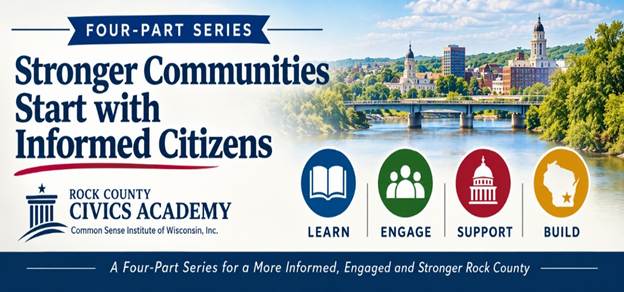
Developing informed citizens, encouraging responsible public service, and strengthening deliberative democracy in Rock County.
A four-Part Essay Series Presented by the Rock County Civics Academy
The purpose of the series
The Rock County Civics Academy (RCCA) is taking this opportunity to contribute something important to the future of local government: encouraging capable, thoughtful, community-minded citizens to consider serving in elected office.
Too often, conversations about local elections begin and end with personalities, political affiliations, campaign promises, and competing opinions about individual issues. Those things can attract attention, but they don’t necessarily tell us what makes someone prepared to serve the public.
Local government needs something more fundamental.
It needs individuals who understand the responsibilities of public office, appreciate the complexity of governing, respect the democratic process, and recognize that public service is about the community—not the individual holding office.
The series, presented over the next four weeks, is designed to establish an RCCA perspective on the qualities, principles, and practical preparation associated with responsible local leadership.
Importantly, this is not a candidate endorsement program, a political recruitment operation, or an effort to advance a particular political philosophy. It is an educational initiative intended to encourage qualified individuals from all backgrounds and viewpoints to consider public service and help them understand what that commitment entails.
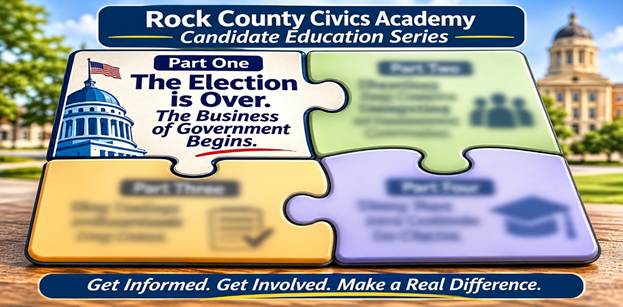
PART ONE
PUBLIC SERVICE IS RESPONSIBILITY, NOT A PERSONALITY CONTEST
What should we look for in those who seek to represent us?
In every election, candidates outline their beliefs, their opposition, and what they pledge to achieve in office.
These matters deserve attention, but a more fundamental question should come first.
What qualities should we seek in those making decisions about our neighborhoods, schools, businesses, taxes, public safety, infrastructure, and community’s future?
The Rock County Civics Academy believes local government is only as strong as the people who take responsibility for governing.
Candidates need not be politicians, hold advanced degrees, or have years of government experience. Some of the most valuable public servants start with little more than genuine concern for their community and a readiness to learn.
Still, certain essential qualities merit consideration. The Rock County Civics Academy believes the difference between winning office and being ready to govern deserves greater attention in election campaigns.
______________________________________________________________________________
REALITY CHECK NUMBER THREE:
What does it take to be an effective public servant? Winning an election is an important achievement. Being prepared to govern is an entirely different responsibility.
______________________________________________________________________________
1. A commitment to community before personal ambition.
Public office is not a platform for personal recognition, an extension of one’s business interests, or an opportunity to settle personal grievances.
It is public trust.
Candidates should understand that their responsibility extends beyond those who voted for them, those who agree with them, or those who share their personal interests.
They represent an entire community.
That requires a willingness to consider competing interests, acknowledge legitimate differences, and make decisions that serve the broader public good.
2. Intellectual curiosity and a willingness to learn.
Local government is complicated.
Municipal finance, land-use planning, economic development, public safety, environmental regulation, infrastructure, and intergovernmental relationships all involve technical, financial, and legal considerations.
Nobody arrives knowing everything.
What matters is whether a candidate is willing to ask questions, examine evidence, consult knowledgeable people, and continue learning.
A willingness to say, “I don’t know, but I intend to find out,” is a valuable leadership characteristic.
3. Independent judgment and intellectual honesty.
Elected officials must be capable of thinking independently.
They should not automatically accept recommendations from staff, special-interest organizations, political allies, business leaders, or vocal constituents without examining the supporting evidence.
Nor should they reject an idea simply because it originated with someone with whom they disagree.
Good judgment requires distinguishing facts from assumptions, opinions from evidence, and political rhetoric from practical consequences.
The objective isn’t to win every argument. It is to make better decisions.
4. Respect for disagreement and the democratic process.
Democracy does not require agreement.
It requires a willingness to work through disagreement constructively.
A candidate should demonstrate the ability to listen without becoming defensive, challenge an argument without attacking the individual, and recognize that people can hold fundamentally different opinions while sharing a commitment to their community.
The ability to build consensus is particularly important in local government, where elected officials frequently must work together long after an election campaign has ended.
5. Accountability, transparency, and ethical conduct.
Public officials must be willing to explain their decisions and accept responsibility for their consequences.
That means respecting open meetings and public records requirements, identifying potential conflicts of interest, being candid about mistakes, and avoiding the temptation to substitute political convenience for public accountability.
Trust is not established by asking people to believe you.
Trust is earned by demonstrating that your actions withstand public examination.
6. A practical understanding of governing.
There is a significant difference between identifying a problem and developing a workable solution.
Responsible candidates recognize that public resources are limited, competing priorities are unavoidable, and every public decision has financial, operational, and community consequences.
They understand that promising something and delivering it are two different things.
They appreciate the importance of long-term planning, responsible budgeting, measurable outcomes, and evaluating alternatives before committing public resources.
7. The courage to reconsider a position.
The most overlooked leadership quality is intellectual humility.
Candidates should be willing to change their minds when presented with credible added information.
Consistency is valuable, but stubbornness is not a substitute for judgment.
A public servant who cannot acknowledge an error or reconsider a position when circumstances change may become more interested in defending yesterday’s decision than serving tomorrow’s needs.
What RCCA is looking for
The Academy isn’t looking for candidates who agree with RCCA.
It is looking for individuals who appreciate the responsibilities of representative democracy and demonstrate the personal qualities necessary to fulfill them.
We believe the best local public servants are not necessarily the loudest, most experienced, or most politically connected individuals.
They are people who care enough to become informed, possess the humility to listen, have the courage to ask tough questions, and understand that public office is an obligation to serve.
The question isn’t simply whether someone wants to hold public office. It’s whether they understand what public office demands of them.
That is where responsible candidacy begins.
_______________________________________________________________________________
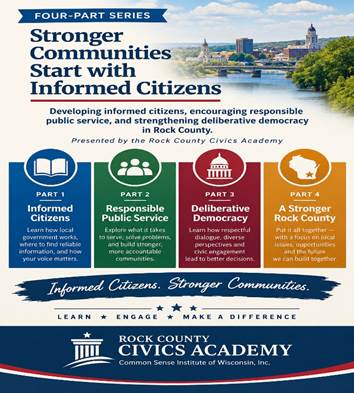
Next week: Don’t Ask for Our Vote Until You Understand the Job!
__________________________________________
SPOTLIGHT ON PROGRESS:

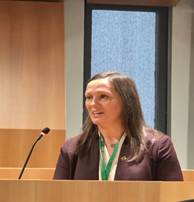
We welcome Rebecca Houseman, Janesville’s twelfth city manager, who was sworn into office on November 2, 2026. RCCA wishes her every success in her new role.
______________________________________________________________________________
Share Hypothetically Speaking – The Voice of Janesville and Rock County Weekly on Substack.com or Subscribe for Free ROCK COUNTY CIVICS ACADEMY | Substack
Public Accountability • Civic Literacy • Common-Sense Conversations
“Democracy flourishes when citizens understand not only how government decides—but why.”
___________________________________________________________________________________
Community Spotlight: Havana Coffee

If you are looking for a place to reflect on your civic journey—or just fuel up before a council meeting—stop by Havana Coffee at 1250 Milton Avenue. It is a true Janesville gem, where espresso meets engagement.
With hearty food, warm service, and a strong commitment to local journalism, Havana Coffee proudly supports the Rock County Civics Academy and all who believe in informed participation.
We are grateful to Daniela and her team for creating a space where ideas percolate and conversations matter.
Nowlan Law Firm and Attorney
Tim Lindau
We also extend our thanks to Attorney Tim Lindau and the Nowlan Law Firm for their support of civic education and democratic renewal. We value Tim’s encouragement—and his belief in the power of our mission.

We extend special thanks to the John and Lynn Westphal family and the Mark and Lori Warren family. Along with John and Lynn, Mark and Lori are deeply committed to this community and its future. Their support for the Rock County Civics Academy and our programs strengthens the outlook for a better Rock County community.


Together, with partners like Havana, Nowlan Law, the John and Lynn Westphal family, and the Mark and Lori Warren family, we are building a culture of engagement that honors both tradition and transformation.

Bill Sodemann and Phones Plus graciously provide in-kind support to RCCA, and we are grateful for their contribution.
HYPOTHETICALLY SPEAKING: Where ideas meet action—and citizens shape the future.
A CALL TO LEADERSHIP
Leadership isn’t about ego—it’s about service.
It’s showing up, listening deeply, and acting with purpose.
Three ways to begin:
• Volunteer with a civic group.
• Serve on a local board or commission.
• Run for public office and lead the change.
“If not you, who? If not now, when?” — Hillel the Elder
📚 SUBSCRIBE FOR INSIGHT
Your weekly dispatch from Wisconsin’s heartland to America’s horizon.
Every Friday, Hypothetically Speaking explores the intersection of policy, people, and possibility—inviting dialogue and celebrating civic courage.
Subscribe on Substack → Search Rock County Civics Academy
📰 substack.com | Keywords: Rock County Civics Academy
🌐 ENGAGED: Civic engagement is always within reach: 📍 rockcountycivicsacademy.org
📘 Facebook | 📺 YouTube | 📰 Substack.
FINAL THOUGHT: Democracy is a skill—one that strengthens with practice.
Stay curious. Stay engaged. Stay connected.
Because the next chapter of Rock County’s story is being written right now.
©2026 Hypothetically Speaking and Rock County Civics Academy. All rights reserved. Produced in partnership with the Rock County Civics Academy to promote open dialogue, ethical leadership, and civic participation across Wisconsin’s heartland. Publisher/Editor: RH Gruber, Correspondents: Paul Murphy, DuWayne Severson, All Illustrations by B. S. MacInkwell, unless otherwise noted. Published by CSI of Wisconsin, Inc. P. O. Box 8082, Janesville WI 53547-8082 (All Rights Reserved)Bottom of Form
No responses yet