The Voice of Janesville and Rock County
PUBLIC ACCOUNTABILITY • CIVIC LITERACY • COMMON-SENSE CONVERSATIONS
Vol. 2, No. 50– November 20, 2026 – 2023 words – a ten-minute read.
____________________________________________________________________________________
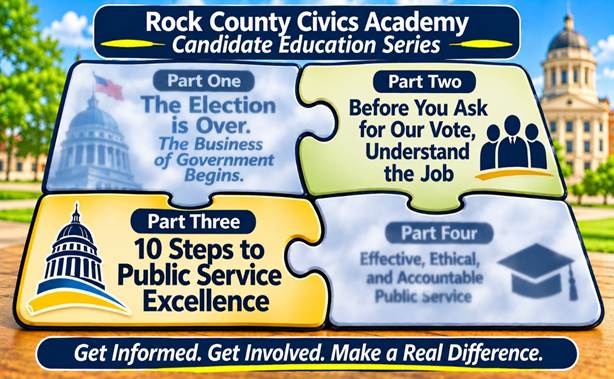
Part Three of RCCA’s Four-Part Series
BEFORE YOU ASK FOR OUR VOTE, ARE YOU READY TO SERVE?
Ten Steps Toward Excellence in Public Service
An Educational Initiative by the Editors of Hypothetically Speaking
Wanting to serve your community is admirable. Understanding what public service requires is essential. Preparing to meet those responsibilities is what separates good intentions from effective leadership.
As we approach another municipal election cycle, prospective candidates should consider an important question:
Are you prepared to do the job you’re asking voters to give you?
Running for public office involves more than collecting signatures, developing campaign slogans, raising money, and asking people for their votes. It requires an understanding of government, a willingness to learn, an appreciation for the responsibilities of elected leadership, and a commitment to serving the entire community.
The Rock County Civics Academy believes candidacy should begin with preparation, not simply campaigning.
Here are ten steps worth considering before deciding to seek public office.
1. KNOW WHY YOU WANT TO SERVE.
Start with an honest examination of your motivations. Are you interested in contributing to your community, or primarily motivated by opposition to a particular person, decision, or development?
Disagreement can inspire civic involvement. But public service requires a commitment that extends beyond a single controversy.
Consider the time, personal responsibilities, potential conflicts of interest, and public scrutiny that accompany elected office.
2. LEARN THE JOB BEFORE YOU APPLY FOR IT.
Every elected position comes with specific responsibilities, limitations, and obligations. Understand the history of the organization you hope to serve, its ordinances, policies, budgets, contracts, strategic plans, and previous decisions.
Know what elected officials are authorized to do, what responsibilities belong to professional administrators, and what limitations are established by state and federal law.
You cannot govern effectively without understanding the institution you are seeking to lead.
3. UNDERSTAND THE RULES.
Public office operates within a legal and ethical framework. Wisconsin’s Open Meetings Law, Public Records Law, ethics requirements, conflict-of-interest provisions, and campaign finance regulations are not optional considerations.
They are fundamental responsibilities.
Transparency and accountability should be more than campaign promises. They must become everyday practices.
4. RESPECT PROFESSIONAL GOVERNMENT.
Effective governance requires a productive relationship between elected officials and professional staff.
Elected officials establish policy, approve budgets, provide oversight, and represent the public. Professional administrators and employees manage operations, provide technical expertise, implement policy, and deliver services.
The responsibilities are different but complementary.
Ask tough questions. Demand accountability. But recognize the importance of professional expertise, administrative continuity, and clearly defined responsibilities.
5. KNOW THE ISSUES AND UNDERSTAND THE MONEY.
A public budget is more than a collection of numbers. It reflects community priorities, available resources, financial limitations, and commitments extending years into the future.
Understand property taxes, other revenue sources, state and federal aid, operating and capital budgets, debt, employee benefits, infrastructure obligations, and long-term financial forecasts.
Read the budget. Examine the financial reports. Understand what proposed policies and development decisions will cost and who pays.
Fiscal literacy is essential to responsible leadership. Promises without an understanding of their financial consequences are little more than campaign rhetoric.
6. RUN A RESPONSIBLE CAMPAIGN.
Explain why you are running, what you hope to accomplish, and how you intend to approach the responsibilities of the office.
Ground your campaign in facts and achieve objectives. Explain your positions without misrepresenting opponents. Follow campaign finance and disclosure requirements. Welcome questions and scrutiny.
And remember: Candidates should not promise what the office they seek does not have the authority to deliver.
The manner in which you conduct your campaign establishes expectations for how you may conduct yourself in office.
Before leaving the topic of money, don’t become a slave accountable to the big dollars that are becoming available to support campaigns for office. With money donations potentially comes big strings.
7. PRACTICE CIVILITY.
Civility does not mean avoiding disagreement or difficult conversations.
It means challenging ideas without attacking individuals, listening without becoming defensive, and communicating honestly without deliberately inflaming tensions.
Can you acknowledge a legitimate opposing argument? Can you explain a difficult decision without dismissing those who disagree?
These are not simply campaign skills. They are governing skills.
8. LISTEN TO THE COMMUNITY.
Representation begins with understanding the people being represented.
Engage residents from different neighborhoods, economic circumstances, professional backgrounds, and perspectives. Talk with business owners, educators, nonprofit leaders, public employees, and people who may not ordinarily participate in government discussions.
Ask questions. Listen to concerns. Learn what people value and what they believe needs improvement.
And don’t stop listening when the election is over.
9. BE PREPARED FOR DAY ONE.
Winning an election is not the completion of preparation. It is the beginning of responsibility.
Understand meeting procedures, governing policies, current budgets, pending contracts, administrative structures, ethics requirements, and public records obligations.
Seeking advice from experienced officials and knowledgeable professionals. Take advantage of available training.
Don’t assume everything can be learned while making decisions that affect the public.
10. SERVE WITH HONOR AND INTEGRITY.
Public service is about trust.
Integrity is demonstrated through everyday conduct: returning constituent calls, reading reports, asking tough questions, disclosing conflicts, acknowledging mistakes, treating people respectfully, and accepting responsibility for decisions.
The authority of public office is temporary. It belongs to the public, not the individual holding the position.
Every elected official should be prepared to make this commitment:
I will act with honesty, listen with humility, and decide with courage. I will respect the law, honor the public trust, and treat those who disagree with me with dignity. I will place the responsibilities of my office above personal ambition and remain accountable to the people I serve.
THE ELECTION IS THE BEGINNING, NOT THE FINISH LINE.
These ten steps are not a political platform, an ideological test, or a requirement that prospective candidates arrive with all the answers.
They are a framework for responsible leadership.
No candidate should be expected to know everything before entering public service. But every candidate should demonstrate a willingness to learn, prepare, and accept accountability.
And that responsibility doesn’t end on election day.
Effective public servants remain students of their communities throughout their terms. They listen, evaluate, deliberate, make decisions, and accept responsibility for the consequences.
Our communities need more than candidates willing to run for office. They need capable, thoughtful, community-minded individuals prepared to govern.
That means asking a little more of ourselves—and a little more of those asking for our votes.
Public trust is not inherited. It is earned, one conversation, one decision, and one act of integrity at a time.
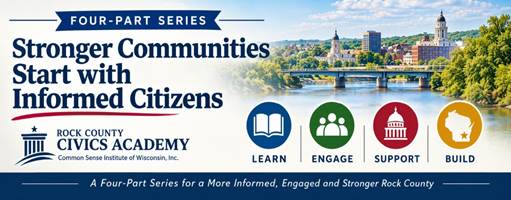
The Rock County Civics Academy believes that becoming an effective public servant shouldn’t depend on knowing the right people or having previous political experience.
It should begin with a willingness to serve—and an opportunity to prepare.
Get informed. Get involved. Make a real difference in your community.
— The Editors of Hypothetically Speaking
An educational initiative of the Rock County Civics Academy

Commentary: Lessons to Learn and Apply
THE SILENCE IS DEAFENING
We’ve Declared a Moratorium on Data Centers. So, What Should Happen Between Now and “Game On Again”?
An Editorial by the Editors of Hypothetically Speaking
Across the country, communities are declaring temporary moratoriums on data center development. Some are pressing pause for six months, others for a year, and some for longer.
Wisconsin is no exception. According to an October 2026 listing compiled by the Wisconsin County Code Administrators Organization, numerous counties have adopted or are considering moratoriums, with durations ranging from 12 to 24 months.
Janesville joined the movement when its City Council unanimously adopted a 12-month moratorium in September.
But here’s the question nobody should overlook:
What exactly are we accomplishing during the pause?
A moratorium is not a development strategy. It doesn’t resolve environmental concerns, establish infrastructure capacity, rewrite zoning ordinances, or determine whether a particular project makes economic sense.
It simply buys time.
And time is valuable only when something productive is done with it.
Nationally, the Urban Institute reported that, as of September 2026, 313 moratoriums had been enacted across 44 states, affecting more than 200 cities, counties, and other local jurisdictions. The reasons are remarkably consistent: communities need time to understand the implications of large-scale facilities and establish appropriate regulatory standards.
Madison, for example, adopted a one-year moratorium in January to develop updated zoning standards. Denver, Minneapolis, Seattle, and New Orleans have pursued variations of temporary restrictions. Aurora, Illinois, used an 180-day pause before adopting a regulatory framework addressing such issues as water, noise, energy, and public engagement.
The lesson isn’t that every community should prohibit data centers.
It’s that communities should establish the rules before entertaining proposals.
Tired of Excuses and Committed to Learning:
Closer to home, the Town of Beloit has launched a new initiative that emphasizes robust public engagement in developing planning guidelines, zoning ordinances, and related frameworks. Their deliberative democracy-based approach to citizen participation is providing valuable insights and helping inform decision-making. Local governments facing complex policy challenges may find this model particularly instructive and are encouraged to contact the Town for more information.
WHAT SHOULD HAPPEN DURING THE PAUSE?
First, local governments need to understand what they’re regulating.
A data center isn’t simply another industrial building. Depending on its size and design, it can have substantial implications for electricity consumption, water availability, backup power generation, noise, air quality, transportation, and surrounding land uses.
Those impacts need to be understood, quantified, and incorporated into enforceable standards.
Janesville has acknowledged that its existing zoning code lacks sufficiently specific classifications and standards for data center development. The City has been working on a broader zoning review and a proposed Data Center Companion Ordinance.
Second, zoning codes need attention. The special zoning ordinance needs to be considered simultaneously with the excerpts of the broader ordinance.
That work should establish clear definitions, appropriate locations, permitting requirements, performance standards, public notification, environmental assessments, and enforceable operating conditions.
Special-use review, rather than automatic by-right approval, deserves sincere consideration for large-scale facilities.
Third, communities need independent technical and financial expertise.
Developers have engineers, attorneys, financial analysts, and consultants working on their behalf. Municipalities need comparable professional assistance to evaluate proposals objectively.
Electricity and water capacity, utility infrastructure costs, environmental consequences, fiscal impacts, tax incentives, employment projections, and potential community benefits should be independently examined.
The Urban Institute’s September 2026 research offers a useful framework, emphasizing accountability, community engagement, revenue, infrastructure, employment, and public land considerations.
These aren’t theoretical concerns. They are the practical homework of responsible government.
WHAT ABOUT JANESVILLE?
Janesville has some additional homework.
The former GM/JATCO property represents approximately 250 acres of complicated redevelopment opportunity. The city has established a Redevelopment Advisory Board and commissioned an 18-month master planning process. That work includes market and feasibility analysis, environmental assessments, infrastructure requirements, and community input.
But how much progress has actually been made? What has the advisory board learned? What information is available to the public? What are the emerging conclusions?
Residents deserve regular, understandable progress reports. And before anyone starts talking about the next development opportunity, Janesville needs answers to some fundamental questions.
First, what can the property actually support?
Not what someone hopes it might accommodate, or what a prospective developer’s preliminary proposal suggests.
What can the property legally, environmentally, physically, and economically support?
That requires a realistic assessment of usable acreage, environmental restrictions, remediation requirements, infrastructure capacity, access, utilities, and surrounding land uses.
Second, what will it cost to make the property marketable?
Environmental remediation alone has been estimated at $30 million, with substantial challenges associated with portions of the northern property.
But remediation is only part of the equation. Infrastructure improvements, site preparation, utility extensions, demolition remnants, and other development costs must also be quantified.
Until those numbers are established, discussions about the property’s potential economic value and redevelopment prospects are premature.
Third, what does the market actually want?
A conceptual master plan should identify realistic alternatives, not simply create an attractive picture of what residents might like to see.
Industrial, commercial, residential, mixed-use, recreational, and other possibilities deserve consideration based on market demand, site capacity, financial feasibility, and community priorities.
The objective should be a realistic development strategy, not another collection of expectations that may disappoint.
A NEW CHAPTER IN CITY LEADERSHIP
Janesville also has a new city manager.
Rebecca Houseman was appointed in November, bringing an opportunity for fresh administrative leadership and a renewed emphasis on transparency, public engagement, and disciplined planning.
The GM/JATCO Advisory Board, City Council, professional staff, and new city manager have an opportunity to establish a more understandable and accountable redevelopment process.
The November referendum has also changed the decision-making landscape. Major projects exceeding the established $450 million threshold involving the GM/JATCO properties will require voter approval.
That is now part of the rules of engagement.
It makes careful planning, public communication, and realistic expectations even more important.
WHAT WON’T HAPPEN AUTOMATICALLY?
The moratorium won’t make developers appear when it expires.
It won’t eliminate environmental liabilities, create additional electrical capacity, guarantee new jobs, or make an otherwise uneconomic property attractive to investors.
And lifting a moratorium won’t mean that a project is automatically approved.
What should happen is more important.
When the pause ends, Janesville and other communities should have updated zoning regulations, reliable technical information, independently evaluated costs, clearly defined approval processes, and meaningful opportunities for public participation.
Only then should it be game on again.
A moratorium is an opportunity, not an accomplishment.
The silence surrounding what happens next shouldn’t be mistaken for progress.
We’ve pressed pause. Now let’s demonstrate that we know what to do with the time we’ve purchased.
Because the objective isn’t simply to decide whether data centers belong in our communities.
It’s to make certain that whatever development we consider is supported by facts, consistent with community priorities, financially responsible, and subject to transparent public accountability.
That’s what responsible local government looks like.
And that’s what residents should expect.
— The Editors of Hypothetically Speaking
_________________________________________________________________________
Share Hypothetically Speaking – The Voice of Janesville and Rock County Weekly on Substack.com or Subscribe for Free ROCK COUNTY CIVICS ACADEMY | Substack

Public Accountability • Civic Literacy • Common-Sense Conversations “
Democracy flourishes when citizens understand not only how government decides—but why.”
___________________________________________________________________________________
Community Spotlight: Havana Coffee

If you are looking for a place to reflect on your civic journey—or just fuel up before a council meeting—stop by Havana Coffee at 1250 Milton Avenue. It is a true Janesville gem, where espresso meets engagement.
With hearty food, warm service, and a strong commitment to local journalism, Havana Coffee proudly supports the Rock County Civics Academy and all who believe in informed participation.
We are grateful to Daniela and her team for creating a space where ideas percolate and conversations matter.
Nowlan Law Firm and Attorney
Tim Lindau
We also extend our thanks to Attorney Tim Lindau and the Nowlan Law Firm for their support of civic education and democratic renewal. We value Tim’s encouragement—and his belief in the power of our mission.

We extend special thanks to the John and Lynn Westphal family and the Mark and Lori Warren family. Along with John and Lynn, Mark and Lori are deeply committed to this community and its future. Their support for the Rock County Civics Academy and our programs strengthens the outlook for a better Rock County community.

Together, with partners like Havana, Nowlan Law, the John and Lynn Westphal family, and the Mark and Lori Warren family, we are building a culture of engagement that honors both tradition and transformation.

Bill Sodemann and Phones Plus graciously provide in-kind support to RCCA, and we are grateful for their contribution.
HYPOTHETICALLY SPEAKING: Where ideas meet action—and citizens shape the future.
A CALL TO LEADERSHIP
Leadership isn’t about ego—it’s about service.
It’s showing up, listening deeply, and acting with purpose.
Three ways to begin:
• Volunteer with a civic group.
• Serve on a local board or commission.
• Run for public office and lead the change.
“If not you, who? If not now, when?” — Hillel the Elder
📚 SUBSCRIBE FOR INSIGHT
Your weekly dispatch from Wisconsin’s heartland to America’s horizon.
Every Friday, Hypothetically Speaking explores the intersection of policy, people, and possibility—inviting dialogue and celebrating civic courage.
Subscribe on Substack → Search Rock County Civics Academy
📰 substack.com | Keywords: Rock County Civics Academy
🌐 ENGAGED: Civic engagement is always within reach: 📍 rockcountycivicsacademy.org
📘 Facebook | 📺 YouTube | 📰 Substack.
FINAL THOUGHT: Democracy is a skill—one that strengthens with practice.
Stay curious. Stay engaged. Stay connected.
Because the next chapter of Rock County’s story is being written right now.
©2026 Hypothetically Speaking and Rock County Civics Academy. All rights reserved. Produced in partnership with the Rock County Civics Academy to promote open dialogue, ethical leadership, and civic participation across Wisconsin’s heartland. Publisher/Editor: RH Gruber, Correspondents: Paul Murphy, DuWayne Severson, All Illustrations by B. S. MacInkwell, unless otherwise noted. Published by CSI of Wisconsin, Inc. P. O. Box 8082, Janesville WI 53547-8082 (All Rights Reserved)
No responses yet