The Voice of Janesville and Rock County
PUBLIC ACCOUNTABILITY • CIVIC LITERACY • COMMON-SENSE CONVERSATIONS
Vol. 2, No. 49 – November 13, 2026 – 1975 words – a ten-minute read.
____________________________________________________________________________________
Part Two of RCCA’s Four-Part Series
Developing informed citizens, encouraging responsible public service, and strengthening deliberative democracy in Rock County
Last week, Part One of the Rock County Civics Academy’s four-part series introduced an important question: What does responsible public leadership look like, and what qualities should we expect of those who seek public office?
This week, we move from principles to practice by looking at the work of local government—and the decisions facing the people elected to lead it.
THE PURPOSE OF THE SERIES
The Rock County Civics Academy is taking this opportunity to contribute something important to the future of local government: encouraging capable, thoughtful, community-minded citizens to consider serving in elected office.
Too often, conversations about local elections begin and end with personalities, political affiliations, campaign promises, and competing opinions about individual issues. Those things attract attention, but they do not necessarily tell us what makes someone prepared to serve the public.
Local government needs something more fundamental. It needs individuals who understand the responsibilities of public office, appreciate the complexity of governing, respect the democratic process, and recognize that public service is about the community—not the individual holding office.
Over four weeks, this series is establishing an RCCA perspective on the qualities, principles, and practical preparation associated with responsible local leadership.
This is not a candidate endorsement program, a political recruitment operation, or an effort to advance a particular political philosophy. It is an educational initiative encouraging qualified individuals from all backgrounds and viewpoints to consider public service and understand what that commitment entails.
__________________________________________________________________________
PART TWO
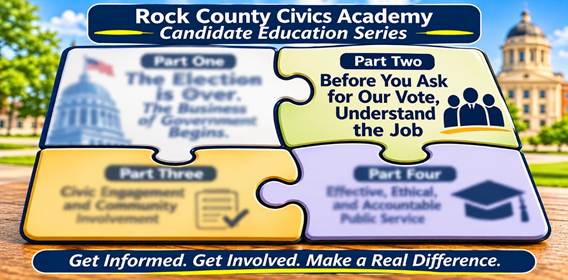
BEFORE YOU ASK FOR OUR VOTE, UNDERSTAND THE JOB
What does service in local government actually require?
One of the challenges facing local government is that many citizens who might make excellent public officials never consider running.
Some believe they lack the necessary experience. Others assume that government is too complicated, that politics is too contentious, or that they must already understand the intricacies of municipal administration before they can be effective.
None of those assumptions should automatically discourage someone.
But there is an important distinction between being interested in public service and being prepared to accept the responsibilities of public office.
The Rock County Civics Academy believes prospective candidates should understand the institution they hope to serve before asking voters to entrust them with its responsibilities.
Understanding the diverse levels of local government
Rock County residents encounter several forms of local government, each with different responsibilities and authority.
Municipal government: Cities, villages, and towns
City councils, village boards, and town boards address the issues most directly affecting residents.
Depending on the municipality, these responsibilities include:
- Land-use planning, zoning, and development.
- Municipal budgets, taxation, and expenditures.
- Streets, roads, utilities, and public infrastructure.
- Police, fire, and emergency services.
- Housing, neighborhood development, and economic growth.
- Parks, recreation, libraries, and community facilities.
- Local ordinances and regulatory responsibilities.
An effective municipal official must understand the relationship between elected leadership, professional administration, municipal employees, advisory boards, and the public.
County government
The Rock County Board of Supervisors has responsibilities extending across municipal boundaries.
County government addresses matters including:
- Public health and human services.
- Criminal justice and corrections.
- County highways and transportation.
- Land conservation and environmental programs.
- County fiscal management and taxation.
- Economic development and regional coordination.
- County facilities and essential services.
County supervisors must appreciate that decisions frequently affect residents throughout the county, not simply the neighborhoods or municipalities they know best.
School boards and other elected or appointed bodies
School board members have responsibilities involving educational policy, district finances, facilities, leadership oversight, and student outcomes.
Other local boards and commissions address specialized responsibilities involving planning, zoning, libraries, conservation, and other public services.
Each position has a different legal framework and scope of authority.
Understanding those distinctions is essential.
Understanding the difference between governing and campaigning
Campaigning is about explaining what you believe should happen.
Governing is about determining what can happen, what should happen, what it will cost, who will be affected, and how the decision will be implemented.
The two activities require different disciplines.
A candidate might campaign on lowering taxes, improving public safety, attracting businesses, or expanding services.
But an elected official must understand the financial and operational implications of those commitments.
For example:
- What does the current budget actually tell us?
- Which expenditures are discretionary and which are legally or operationally required?
- What are the long-term maintenance costs of a proposed capital improvement?
- What are the consequences of delaying an infrastructure investment?
- What alternatives exist?
- How will the public know whether the promised outcome was achieved?
These are governing questions.
Candidates who understand the difference are better positioned to appreciate the responsibilities they are seeking.
Seven questions every prospective candidate should ask
Before deciding to run, RCCA encourages prospective candidates to consider seven questions:
- Why do I want to serve? Is my motivation rooted in community service, or primarily in disagreement with a particular person, decision, or policy?
- What do I understand about the office? Have I studied its legal authority, responsibilities, limitations, and time commitments?
- Am I prepared to learn? Can I collaborate with professional staff, examine technical information, and acknowledge when I need additional expertise?
- Can I collaborate with people who disagree with me? Am I willing to collaborate with colleagues whose political, philosophical, or personal perspectives differ from mine?
- Can I make complex decisions? Am I prepared to weigh competing interests, recognize financial limitations, and accept that not everyone will be satisfied?
- Am I willing to be accountable? Can I explain my decisions publicly, acknowledge mistakes, and accept responsibility for the consequences?
- Can I commit the necessary time and attention? Do I understand the preparation, meetings, constituent responsibilities, and continuing education involved?
These questions are not intended to discourage anyone.
They are intended to encourage thoughtful preparation.
Representative democracy requires both participation and responsibility
The Academy believes strongly in citizen participation.
But participation does not mean that every decision should be made by popular vote, nor does it diminish the responsibilities of elected representatives.
We elect individuals to exercise judgment on our behalf.
That authority carries an obligation to listen, investigate, deliberate, and make decisions in the public interest.
The public has a responsibility to remain informed and engaged. Elected officials have a responsibility to govern openly and accountably.
Both are essential.
The quality of local government depends upon the relationship between an informed citizenry and representatives who understand the responsibilities entrusted to them.
We should expect candidates to understand the job before they ask us to give it to them. And we should make sure the resources exist to help them succeed.
_____________________________________________________________________________
Next Week:
TEN STEPS TO EXCELLENCE IN PUBLIC SERVICE
______________________________________________________________________________
Commentary: Lessons to Learn and Apply
EVERYONE SHOULD BE HELD TO TRUTH-IN-ADVERTISING STANDARDS
There is no place for convenient fiction in public discourse.
During the GM/JATCO referendum campaign, some advocates repeatedly said there were no other referendums in the United States like the one Janesville voters were being asked to decide. In fact, nationally at least forty-one communities had ballot questions related to data center development on their November ballot, and 40 of 41 approved referendums addressing data center development and imposing restrictions on such projects to varying degrees. That record was worth knowing before voting — and it didn’t fit the campaign narrative.
Another claim heard often was that passage would permanently stop development and good-paying jobs from coming to the community. That overstated what the referendum did. It did not prohibit development or eliminate economic opportunity; it established a voter-approval requirement for certain major development and property transactions. There is a real difference between requiring public accountability and permanently stopping economic progress, and voters deserve the fuller picture.
Really?
Fortunately, Janesville voters were capable of looking beyond the rhetoric, finding their own sources of information, and making independent judgments about the facts. Or they simply recognized the negativity, exaggeration, and fear-based messaging for what it was and responded with a collective thumbs down.
Either way, voters deserve better.
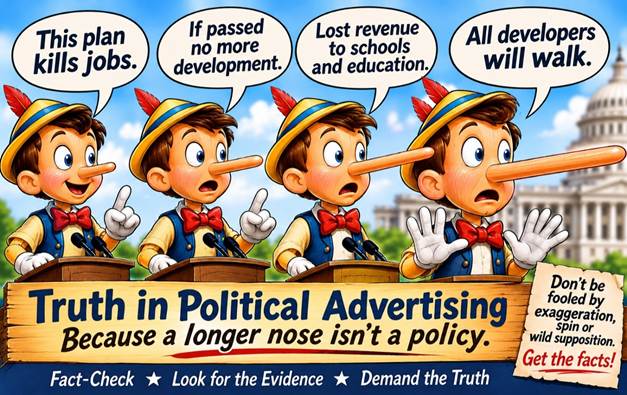
Campaign literature and political rhetoric should educate, inform, and encourage thoughtful debate—not mislead, distort, or substitute convenient narratives for inconvenient realities.
Political advocacy is not a license to disregard facts. If we expect transparency, accountability, and honesty from our elected officials, those same standards must apply to everyone seeking to influence public opinion.
____________________________________________________________________________________
Fondest wish, hope, and simple standard of ethical behavior:
As we enter another municipal election cycle, let’s hope candidates, organizations, and their supporters choose a higher standard. Challenge ideas, question assumptions, and advocate passionately. But do so with facts, intellectual honesty, and respect for voters.
____________________________________________________________________________________
Our democracy deserves better than convenient fiction. And so do our communities.
Commentary by RH Gruber
__________________________________________________________________
THE WEEK THAT WAS — AND THE WEEK AHEAD
Local government in action across Rock County | November 2026
The November 3 election is behind us. Now the work of governing moves forward. Across Rock County, the coming week brings consequential decisions involving municipal and county budgets, taxes, public services, intergovernmental cooperation, and education.
THE WEEK THAT WAS
Janesville entered a new administrative chapter with the November 2 swearing-in of City Manager Rebecca Houseman. The City Council’s October 26 meeting also advanced consideration of redevelopment proposals for the city-owned property at 2400 Beloit Avenue, directing staff to begin negotiations with Next Generation. That project will bear watching as the city considers its housing and development priorities.
In Milton, an Intergovernmental Negotiating Ad Hoc Committee met on November 4 to discuss agreements with surrounding townships. The discussion is important because cooperation across municipal boundaries can affect service delivery, planning, and the future costs of local government. The agenda identified discussion and action; the available record does not establish a final agreement.
The School District of Janesville also received a significant message from voters: preliminary results showed 53 percent support for its four-year operating referendum. The district says the funding will help sustain staffing, programs, and day-to-day operations for more than 8,876 students. The next challenge is translating voter authorization into responsible budget decisions.
THE WEEK AHEAD
Public Accountability • Civic Literacy • Common-Sense Conversations
JANESVILLE: ANOTHER REFERENDUM ON THE HORIZON
Monday’s Janesville City Council meeting advanced consideration of an operational referendum seeking voter authorization to exceed Wisconsin’s property tax levy limits. The proposed question is headed toward the April 2027 ballot and would provide additional operating revenue for the City’s 2028 budget.
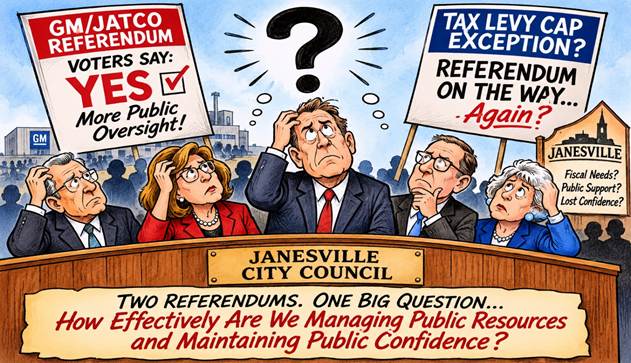
The timing deserves attention. Janesville voters have just approved a referendum establishing greater public oversight of major development decisions involving the former GM/JATCO property. Now they may be asked to approve additional property taxes to support municipal operations.
These are separate issues, but they share an important underlying question: How effectively are elected officials managing public resources and maintaining public confidence?
The new City Manager has only recently taken office. Before declaring that additional taxing authority is necessary, residents deserve a clear explanation of the financial circumstances driving the request.
What is creating the operating shortfall? How much additional revenue will be needed? Which services and expenditures will it support? What alternatives have been considered? And what happens if voters say no?
A referendum should not substitute for a comprehensive financial explanation. Transparency and sound financial planning should come first; a request for additional taxpayer support should follow.
ROCK COUNTY: THE 2027 BUDGET IS APPROVED
The Rock County Board has now approved its 2027 spending plan, completing another important round of local government budget decisions.
The budget addresses rising operating costs, including employee health insurance, while working within the constraints of Wisconsin’s property tax levy limits. County officials have also identified additional Medicaid funding to help reduce the local tax levy burden associated with Rock Haven.
The approval settles the county’s immediate spending plan, but the larger questions remain: Are resources being directed toward the services residents need most, and are county operations structured to remain financially sustainable?
One particularly interesting development involves Rock Haven, the county-owned skilled nursing facility.
On Thursday, November 12, the County Board will consider authorizing Rock Haven to accept referrals and residents from outside Rock County. Opening the facility to a broader regional population could improve utilization, generate additional revenue, and strengthen its long-term financial position.
It also raises legitimate questions about available capacity, staffing, reimbursement rates, operating costs, and the implications for Rock County residents.
Expanding access may be a sensible business and public-service decision. But the financial and operational case should be clearly understood before the policy is adopted.
WEDNESDAY, NOVEMBER 11 — COUNTY SERVICES AND OVERSIGHT
Rock County’s Health Services Committee, Human Services Board, and Agriculture and Extension Education Committee are scheduled to meet.
These agencies oversee programs that directly affect residents’ quality of life, from public health and long-term care to social services and agricultural education.
Their work may not attract the attention generated by elections and referendums, but it represents a substantial portion of local government’s day-to-day responsibilities.
THURSDAY, NOVEMBER 12 — DEVELOPMENT, FINANCES AND PUBLIC POLICY
Several important county meetings are scheduled.
The Planning and Development Committee meets at 8 a.m., with responsibility for county planning, zoning, housing, land division, and community development.
The Finance Committee meets at 5 p.m. to consider financial authorizations, grant funding, and other administrative matters.
At 6 p.m., the full County Board meets. Among its significant agenda items are:
- Authorization for Rock Haven to accept out-of-county referrals and residents.
- Adoption of the Rock River Heritage Park Master Plan.
- Adoption of the County Emergency Operations Plan.
- Acceptance of federal Adult Treatment Court grant funding.
- Additional county administrative and policy matters.
These decisions deserve public attention because they involve more than routine government administration. They affect county assets, service delivery, public safety, and the future allocation of taxpayer resources.
THE BIGGER PICTURE
Rock County’s budget is approved. Janesville is preparing to ask voters for additional operating revenue. Rock Haven may expand its service population. And decisions involving development, public services, and county assets continue.
Taken together, these developments illustrate why informed citizenship cannot begin and end with election campaigns.
Elected officials have the authority and responsibility to govern. Residents have every right to expect competent management, transparent financial decisions, and a credible explanation of public policy choices.
Elections choose representatives. Budgets reveal priorities. Public meetings provide accountability.
The public’s responsibility does not end at the ballot box. It begins again when the meetings start.
___________________________________________________________________________
Share Hypothetically Speaking – The Voice of Janesville and Rock County Weekly on Substack.com or Subscribe for Free ROCK COUNTY CIVICS ACADEMY | Substack
Public Accountability • Civic Literacy • Common-Sense Conversations
“Democracy flourishes when citizens understand not only how government decides—but why.”
___________________________________________________________________________________
Community Spotlight: Havana Coffee

If you are looking for a place to reflect on your civic journey—or just fuel up before a council meeting—stop by Havana Coffee at 1250 Milton Avenue. It is a true Janesville gem, where espresso meets engagement.
With hearty food, warm service, and a strong commitment to local journalism, Havana Coffee proudly supports the Rock County Civics Academy and all who believe in informed participation.
We are grateful to Daniela and her team for creating a space where ideas percolate and conversations matter.
Nowlan Law Firm and Attorney
Tim Lindau
We also extend our thanks to Attorney Tim Lindau and the Nowlan Law Firm for their support of civic education and democratic renewal. We value Tim’s encouragement—and his belief in the power of our mission.

We extend special thanks to the John and Lynn Westphal family and the Mark and Lori Warren family. Along with John and Lynn, Mark and Lori are deeply committed to this community and its future. Their support for the Rock County Civics Academy and our programs strengthens the outlook for a better Rock County community.


Together, with partners like Havana, Nowlan Law, the John and Lynn Westphal family, and the Mark and Lori Warren family, we are building a culture of engagement that honors both tradition and transformation.

Bill Sodemann and Phones Plus graciously provide in-kind support to RCCA, and we are grateful for their contribution.
HYPOTHETICALLY SPEAKING: Where ideas meet action—and citizens shape the future.
A CALL TO LEADERSHIP
Leadership isn’t about ego—it’s about service.
It’s showing up, listening deeply, and acting with purpose.
Three ways to begin:
• Volunteer with a civic group.
• Serve on a local board or commission.
• Run for public office and lead the change.
“If not you, who? If not now, when?” — Hillel the Elder
📚 SUBSCRIBE FOR INSIGHT
Your weekly dispatch from Wisconsin’s heartland to America’s horizon.
Every Friday, Hypothetically Speaking explores the intersection of policy, people, and possibility—inviting dialogue and celebrating civic courage.
Subscribe on Substack → Search Rock County Civics Academy
📰 substack.com | Keywords: Rock County Civics Academy
🌐 ENGAGED: Civic engagement is always within reach: 📍 rockcountycivicsacademy.org
📘 Facebook | 📺 YouTube | 📰 Substack.
FINAL THOUGHT: Democracy is a skill—one that strengthens with practice.
Stay curious. Stay engaged. Stay connected.
Because the next chapter of Rock County’s story is being written right now.
©2026 Hypothetically Speaking and Rock County Civics Academy. All rights reserved. Produced in partnership with the Rock County Civics Academy to promote open dialogue, ethical leadership, and civic participation across Wisconsin’s heartland. Publisher/Editor: RH Gruber, Correspondents: Paul Murphy, DuWayne Severson, All Illustrations by B. S. MacInkwell, unless otherwise noted. Published by CSI of Wisconsin, Inc. P. O. Box 8082, Janesville WI 53547-8082 (All Rights Reserved)Bottom of Form
No responses yet